
This is an old revision of the document!
Braille Printer
Introduction
This project implements a complete version of a braille printer. You just insert your sd card with the desired files, select the one you want, insert the paper, and the print is done!.
I picked this project based on one question:
What can I build using scrap i have in my house for some reason?
After searching inside some boxes I found the main part of an old printer. (the head that moves on the x axis in order to put the ink down)
So this project was (almost) built without paying for anything.
General Description
Let's say, for whatever reason, that you want to send a letter to a blind person, or maybe you have someone blind in your circle/family. This project was thought as something very plug and play, that anyone can build at home with somewhat minimal materials. Someone with minimal coding experience can download this from github and make their own at home!
Main Workflow
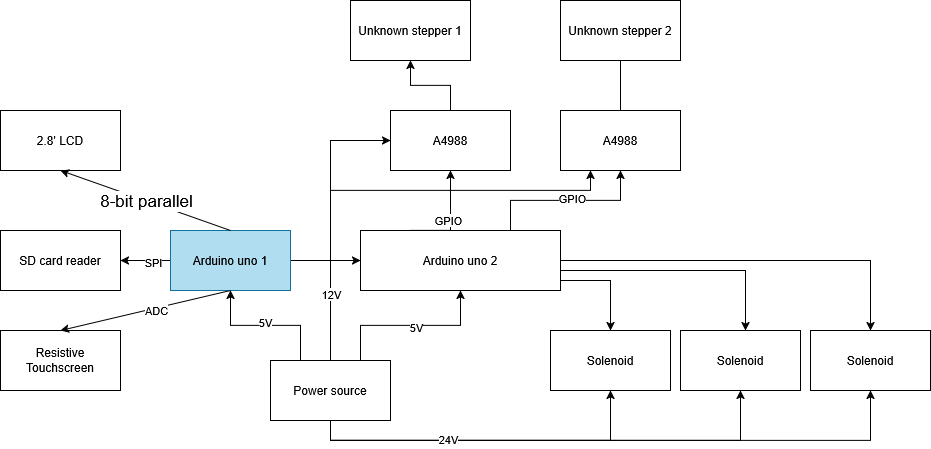
An Arduino uno has a LCD screen (shield) on top of it. Let's call this arduino: arduino 1. This is the brain of the operation.
When the user want to print a .txt file, he inserts the sd card containing the file he wants in the sd card reader on the bottom of the LCD shield.
When powered on, the screen greets the user. After pressing the start button, the user can select the file he wants to print using the touch screen. After selecting the file, the second arduino comes into play. This is the muscle of the operation, so let's call it arduino 2.
When a file is selected, a custom communication protocol (over uart) is initiated. Arduino 1 sends the characters one by one, but only after arduino 2 acknowledges that his job (the printing) is done.
While the printing is happening, arduino 1 displays all the letters, numbers or special characters, alongside their braille representation, and a progress bar.
When both arduinos finish working, everything resets, allowing the user to print a second time.
The paper will be printed in reverse, so it will start from the right. Each letter in the braille alphabet is built from two columns of 3 rows of dots, so 6 in total. The printer pushes only one column at a time (so maximum 3 dots at once). The head of the machine moves only on the x axis.
Hardware Design
For this project to work I had to use two arduino uno boards (for gpio reasons).
Here is a list of every component:
- Arduino uno (the brain) - let's call it 1
- Arduino uno (the consumer) - let's call it 2
- ILI9341 2.8' LCD with touchscreen
- SD-card reader (from the lcd shield)
- 2 stepper motors (bipolar, 12V, don't know the name)
- 2 A4988 drivers
- 3 push solenoids (built myself because they are small)
- 3 x Transistors
- 2 x Condenser: 100 nf
- One 24V power source
- n x Step-down Converter
=== Main Circuit===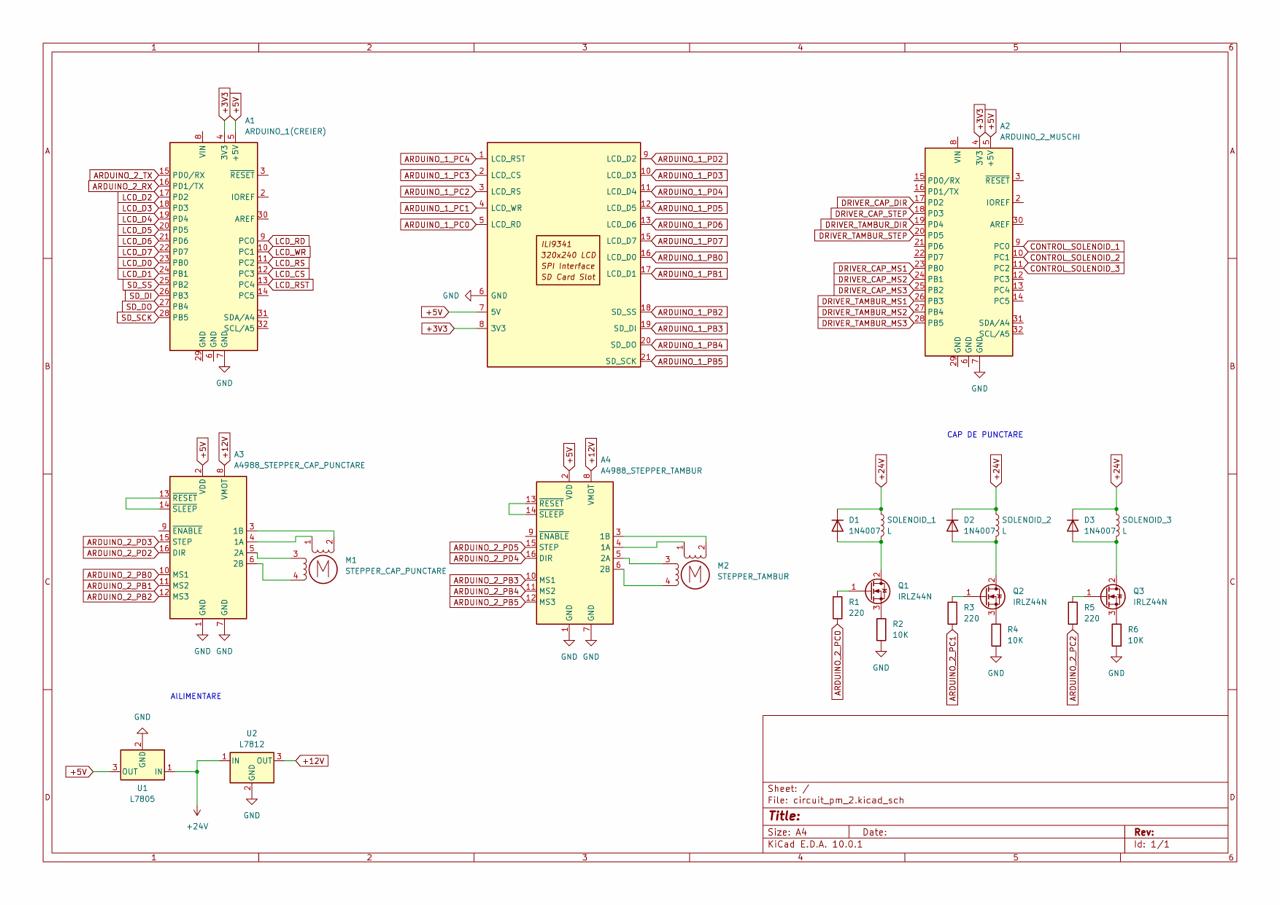
- Am pus 3 surse, pentru ca voi opera cu 3 tensiuni diferite si nu sunt circuite de step
Aici puneţi tot ce ţine de hardware design:
- listă de piese
- scheme electrice (se pot lua şi de pe Internet şi din datasheet-uri, e.g. http://www.captain.at/electronic-atmega16-mmc-schematic.png)
- diagrame de semnal
- rezultatele simulării

Software Design
- mediu de dezvoltare (if any) (e.g. AVR Studio, CodeVisionAVR)
- librării şi surse 3rd-party (e.g. Procyon AVRlib)
- algoritmi şi structuri pe care plănuiţi să le implementaţi
- (etapa 3) surse şi funcţii implementate
Rezultate Obţinute
Concluzii
Download
 .
.
Fişierele se încarcă pe wiki folosind facilitatea Add Images or other files. Namespace-ul în care se încarcă fişierele este de tipul :pm:prj20??:c? sau :pm:prj20??:c?:nume_student (dacă este cazul). Exemplu: Dumitru Alin, 331CC → :pm:prj2009:cc:dumitru_alin.
Jurnal
Bibliografie/Resurse


